What Is an Accessory Dwelling Unit (ADU)?
An Accessory Dwelling Unit (ADU) is a smaller, self-contained residential unit that shares the same lot as a primary home. ADUs provide a way to create additional living space — whether for family members, guests, or tenants — while potentially enhancing property value and functionality. Thanks to Local Law 127 of 2024 (LL127), New York City homeowners now have the opportunity, for the first time, to add ADUs legally under the city's pilot program.
ADUs are designed to increase housing options, support multi-generational living, and help property owners make better use of existing land and structures — all while preserving neighborhood character. SpecLand Group specializes in helping homeowners navigate the complexities of LL127 and build an ADU that fits their vision, their property, and NYC's strict regulations.
The Five Types of ADUs Recognized in NYC
Under Appendix U of LL127, NYC recognizes several forms of ADUs that may be permitted depending on a property's zoning, location, and layout. Each type carries its own design considerations and regulatory requirements.
- Detached ADU (Backyard Cottage / Guesthouse): A completely separate structure on the same lot as the main residence. As a detached ADU builder, SpecLand Group works with homeowners to design these units to maximize usable space while meeting setback, height, and lot coverage requirements. Detached ADUs are well-suited for providing independent housing for family members, accommodating long-term guests, or generating rental income.
- Attached ADU: Built as an addition to the primary home, sharing at least one wall, while maintaining separate living quarters.
- Garage Conversion ADU: A garage conversion contractor approach that transforms an existing garage into a livable residential unit — often a cost-effective way to make use of underutilized space.
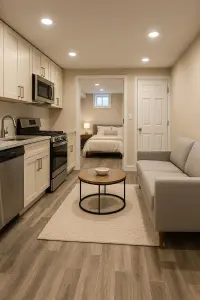
- Basement ADU: Converts existing lower-level space into a legal residential unit, requiring careful attention to egress, moisture protection, and lighting requirements under NYC code.
- Internal ADU (Carve-Out): Reconfigures existing space within the main house — such as unused upper floors or side wings — to create an independent living unit with its own entrance.
SpecLand Group helps homeowners determine which ADU type is appropriate for their property and manages the design, permitting, and construction process from start to finish.
Why Build an ADU in NYC — and Why Work with SpecLand Group?
ADUs represent a relatively new opportunity for New York City homeowners. While accessory dwelling units have been common in other cities for years, they are only now becoming a legal option in NYC. SpecLand Group positions itself as a dedicated ADU contractor in New York City, focused specifically on helping homeowners design and build compliant ADUs under the new regulatory framework.
There are several practical reasons homeowners consider building an ADU:
- Family housing: An ADU can provide a private, comfortable space for aging parents, adult children, or live-in caregivers — keeping family close while maintaining independence.
- Rental income: In a city with limited housing supply, a legal, code-compliant ADU can serve as a rental unit and provide long-term financial benefit.
- Guest accommodations: A self-contained unit with its own entrance, bathroom, and kitchen offers guests privacy without disrupting the main household.
- Better use of existing space: Garages, basements, and backyard areas that currently sit underused can be converted into functional living quarters.
Building a legal ADU in NYC is not a straightforward process. The path involves navigating zoning compatibility, dimensional standards, egress requirements, utility connections, fire safety provisions, and Department of Buildings approvals — all of which can vary significantly depending on the specific property. LL127's Appendix U alone runs to dozens of pages of technical standards and conditions.
Key questions that must be answered before design even begins include:
- Does the lot qualify under the pilot program's designated geographic areas?
- Is the property's zoning district compatible with an ADU?
- Will the proposed unit meet the dimensional, egress, and utility requirements in Appendix U?
- How do fire safety, accessibility, and parking provisions affect the design?
- What approvals are required from the Department of Buildings, and in what sequence?
Getting these details wrong can result in delays, unexpected costs, or a project that cannot move forward at all. SpecLand Group brings together design, construction, and permitting expertise under one roof, helping homeowners avoid the common pitfalls of attempting to manage an ADU project independently in NYC's complex regulatory environment.
As an ADU builder operating within NYC's pilot program framework, SpecLand Group stays current with evolving ADU regulations so their clients don't have to interpret complex legal documents or manage city processes on their own.